

Journal ·
Why light spoils olive oil
Once it leaves the mill, olive oil has only two real enemies: light and air. Light is the reason my oil never sees daylight.
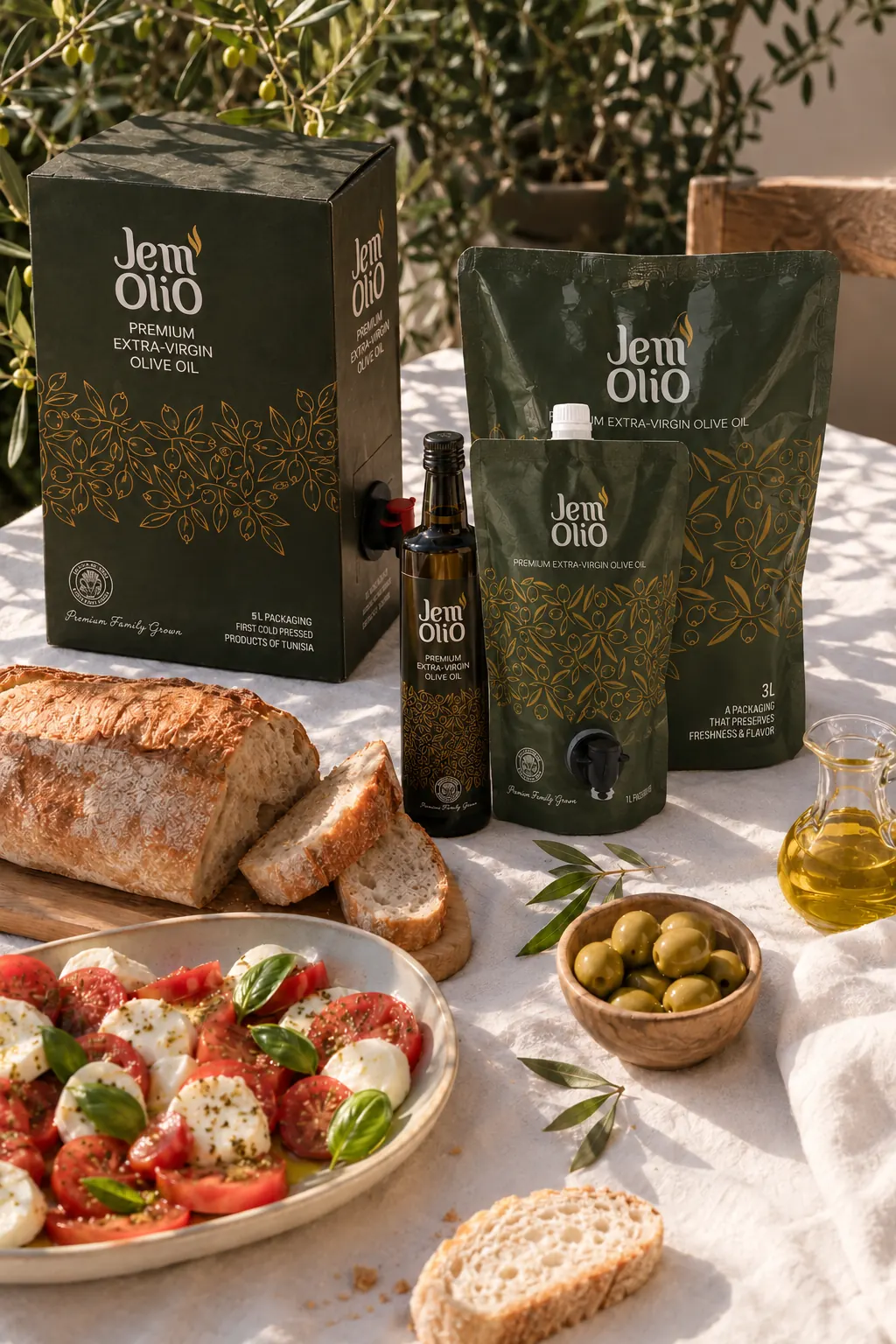
The Bag-in-Box, the two pouches and the bottle: none of them lets daylight through.
An oil left as it is
Extra virgin olive oil is a fruit juice. It leaves the mill exactly as the olive gave it: nothing refined, nothing added. That is what keeps its notes of grass and leaf, its bitterness, its peppery edge, and the compounds chemists call polyphenols. It is also what makes it fragile. A refined oil has already lost almost all of that, so it has little left to lose. Mine has a great deal.
The damage has a name: oxidation. Oxygen slowly attacks the fatty acids in the oil, the aromas fade, and eventually the oil turns rancid. As the International Olive Council (IOC) points out in its consumer guide, you smell this defect before you taste it, and it is the simplest sign that oxidation is under way.
What light does
Fresh oil contains chlorophyll, the green pigment of the olive. In the dark, the pigment is harmless. In the light, it absorbs energy and passes it on to the oxygen in the oil, which becomes far more reactive. This is called photo-oxidation. Light does not warm the oil; it speeds up the reaction that ages it.
The IOC does not mince its words. Its consumer guide states that the main threat to olive oil quality is light, with heat only in second place. Its best practice guidelines for producers and distributors list light, heat, oxygen and chlorophyll among the factors that speed up oxidation. They call for packaging that shields the oil from light, and for dimly lit storerooms kept between 13 and 25 °C.
What the research shows
In a study published in 2014, a team of Tunisian researchers kept Chemlali extra virgin olive oil for six months, exposed to light and at room temperature, in four kinds of container: clear glass, dark glass, polyethylene plastic and tinplate. Tinplate and dark glass protected the oil best. In clear glass and plastic, the pigments and polyphenols fell markedly, and the oil lost quality month after month.
Work in Spain on a different variety, Picual, points the same way. After ten months, oil kept in glass, which lets in more light, had deteriorated faster than oil kept in tins. Study after study, the lesson is the same: what matters is how much light reaches the oil.
Why my containers are opaque
That question decided everything else. My pouch is opaque, so the oil inside never sees the light from the first pour to the last, and the pouch reseals after every use. The Bag-in-Box is a vacuum-filled, UV-blocking bag inside a carton. The bottle, the one you give as a present or put on the table, is dark tinted glass. It is the prettiest of the three, and the one I would suggest you finish first once it is open.
At home
Even the best container cannot do everything. The IOC gives a few simple rules, and I am happy to pass them on:
- keep the oil in a closed cupboard, away from the oven, the hob and the window;
- close it tightly after each use, because air finishes what light begins;
- once opened, use it within one to three months;
- buy no more than you will use in a year. Olive oil is not wine: it does not improve with age.
If you like to decant it into a cruet by the hob, choose an opaque one, keep it small and refill it often. The IOC recommends the same: transfer the oil from a large container into a smaller one made of dark glass, ceramic or stainless steel, and keep it away from the light.
Malek
Sources
- International Olive Council, Consumer guidelines on the best storage conditions for olive oils and olive pomace oils, COI/CBPS/Doc. No 1, November 2020 (PDF).
- International Olive Council, Best practice guidelines for the storage of olive oils and olive-pomace oils for human consumption, COI/BPS/Doc. No 1, 2018 (PDF).
- B. Gargouri, A. Zribi, M. Bouaziz, Effect of containers on the quality of Chemlali olive oil during storage, Journal of Food Science and Technology, 2014.
- E. Martín-Tornero, A. Fernández, I. Durán-Merás, D. Martín-Vertedor, Fluorescence Monitoring Oxidation of Extra Virgin Olive Oil Packed in Different Containers, Molecules, 2022.
External links, opened in a new tab.