

Journal ·
One harvest a year
Nothing is left of the 2025-2026 harvest. What you can reserve today is the 2026-2027 harvest, and picking starts in early November. Here is how it goes, and why I sell by reservation.
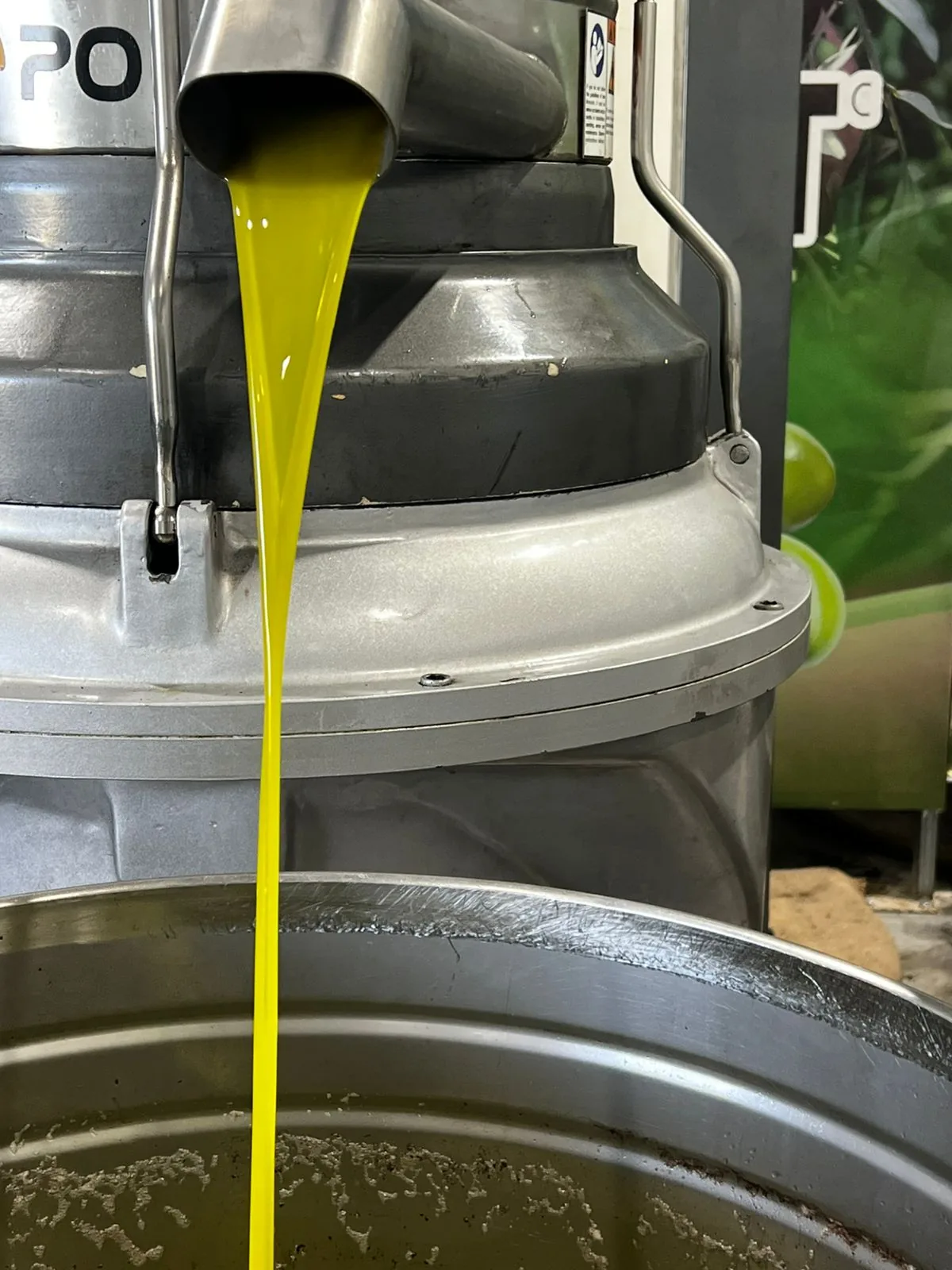
New oil, on picking day.
The tree's calendar
An olive tree flowers in spring, sets its fruit in early summer, lets it swell through the heat and ripens it in autumn. There is no second flowering and no catching up: whatever the tree has not carried by autumn will not be picked until the following year. Three hundred trees give only once a year.
That is why the trade counts its seasons across two calendar years. We speak of the ‘2026-2027 harvest’ because picking begins in the autumn of 2026 and the oil it gives will be on tables throughout 2027.
No two years alike
The size of the crop, though, changes from year to year. Winter rain, heat at flowering time, wind: it all counts. And Chemlali has habits of its own. The world catalogue of olive varieties kept by the International Olive Council (IOC) notes that it has a strong tendency to alternate bearing, especially without irrigation: a heavy year is often followed by a lighter one.
So I only know the exact quantity at picking time, when I can see what the trees have carried.
Early November, by hand
Picking starts in early November. The olives are gathered by hand, tree by tree, so the fruit is not bruised: a bruised olive spoils quickly, and it shows in the oil. During the harvest I go round the trees one by one.
The olives go to the mill the same day. This is no small detail. Olives left in a heap begin to ferment, and their oil then has a defect that tasters spot at once. The IOC tasting method gives it a precise name, ‘fusty’: the flavour of oil from olives piled or stored for so long that they have fermented. Milling on the day of picking is the simplest way to make sure you never come across it.
Why I sell by reservation
With one harvest a year, and a quantity I only learn at picking time, I would rather not promise what the trees may not give. So I take each request in the order it reaches me and allot the oil before pressing, within the limit of what the trees have carried. The oil is shipped after the November pressing.
It is also a question of freshness. The IOC says so in its advice to consumers: olive oil is not wine and does not improve with time, so it is best to buy only what you will use within a year. Reserving from the harvest means you receive this year's oil, not oil that has sat waiting for a buyer.
How to reserve
You can make a one-off reservation, or take out a subscription if you would rather receive your oil at your own pace through the year: every month, every two months or every three, with no minimum term. The sizes and prices are in the shop.
And when your one-litre pouch is empty, there is no need for a new one: I refill it, and you pay only for the oil and the shipping. One harvest a year, one pouch that keeps coming back: that is the rhythm I like best.
Malek
Sources
- International Olive Council, World catalogue of olive varieties, “Chemlali Sfax” entry: maturity and alternate bearing.
- International Olive Council, Sensory analysis of olive oil. Method for the organoleptic assessment of virgin olive oil, COI/T.20/Doc. No 15/Rev. 11, June 2024, vocabulary of defects (PDF).
- International Olive Council, Consumer guidelines on the best storage conditions for olive oils and olive pomace oils, COI/CBPS/Doc. No 1, November 2020 (PDF).
External links, opened in a new tab.