

Journal ·
Chemlali, and what you taste in the glass
Small and almost plain to look at, Chemlali is my country's olive. Since my training in sensory analysis, I have learnt to describe its oil in the language of a tasting panel.
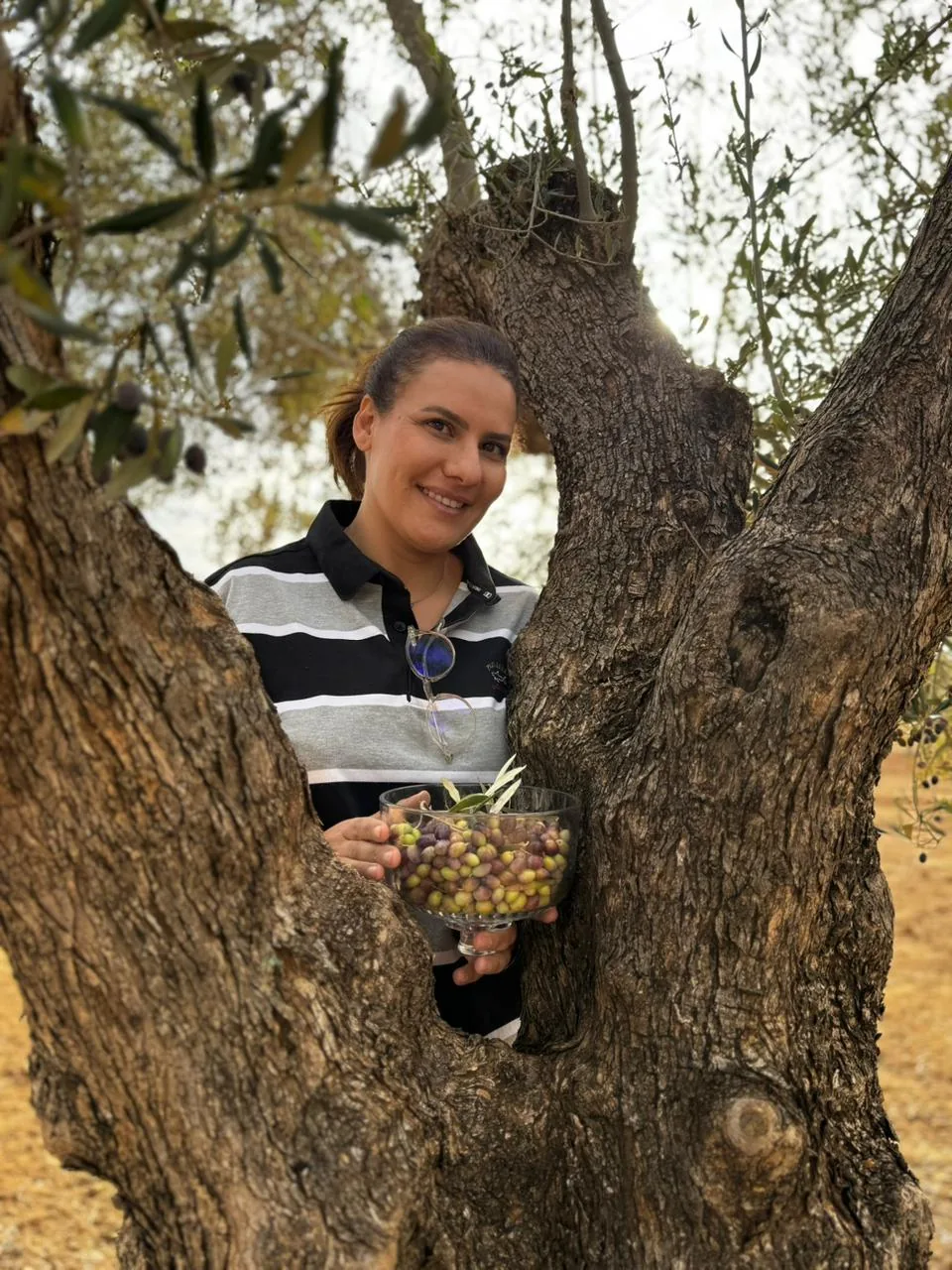
In the branches, at picking time.
The olive of central Tunisia
Chemlali comes from the Sfax region, in the centre of the country, and is grown throughout central and southern Tunisia. The world catalogue of olive varieties kept by the International Olive Council (IOC) calls it Tunisia's main oil variety: it covers more than half of the country's olive-growing land and accounts for nearly seven trees in ten. Drive along the Sahel coast and the olive trees you see from the road are almost always Chemlali.
It is also the variety of my own grove, at Gharess Chogran Lahkeima near Mahdia. My great-grandfather planted these trees, and four generations have pruned them since. I never had to choose Chemlali. It was there before me.
A tree made for dry land
The catalogue describes a vigorous tree, well suited to dry soils and heat, tolerant of drought, with small, oil-rich fruit. Around Sfax it grows in vast rain-fed groves, with the trees planted very far apart. On my land they stand eighteen metres apart, in clay-loam soil that holds water well, a few kilometres from the sea. Eighteen metres is what gives each tree enough light to ripen properly.
Chemlali ripens early: the catalogue puts its maturity in November. That is why my picking begins in early November.
Tasting like a panel
In May 2026, in Tunis, I took a forty-hour training course in the sensory analysis of virgin olive oils, run by the IOC with the Mediterranean Agronomic Institute of Zaragoza and Tunisia's National Oil Office. What it teaches is a method: the one set out by the IOC and followed by tasting panels. The oil is served in a small covered glass, warmed to 28 °C. You smell first, then taste, and score the intensity of each sensation on a profile sheet.
The method recognises three positive attributes (fruity, bitter and pungent) and a series of defects, from rancid to musty. Fruitiness depends on the variety and comes from sound, fresh olives. Bitterness and pungency, which many people take for faults, in fact count among the qualities of a virgin olive oil. An oil with no bitterness that never catches in the throat is not necessarily finer. More often it is simply flatter.
What I taste in mine
On the nose, freshly cut grass and olive leaf. On the palate it is round, with a gentle bitterness and a touch of pepper that comes at the end, at the back of the throat, and never takes over. It is an oil that goes with the food rather than stealing the show.
The bottle comes in two intensities. Mild is the gentler one. Medium, from the early picking, is fuller. The IOC catalogue says as much of the variety: picked early, Chemlali gives an intense fruitiness with slight bitterness and a peppery finish.
Tasting it at home
You do not need a proper tasting glass. Pour a little oil into a small glass, cover it with your hand and warm it for a moment. Smell it. Then take a small sip and draw some air in through your teeth: that is when the pepper comes through.
Then take it to the table. A tomato salad with sea salt, grilled vegetables, steamed fish with lemon. In the morning, eggs fried in Chemlali with a slice of country bread. And for a surprise, a few drops on vanilla ice cream with a pinch of sea salt.
Malek
Sources
- International Olive Council, World catalogue of olive varieties, “Chemlali Sfax” entry.
- International Olive Council, Sensory analysis of olive oil. Method for the organoleptic assessment of virgin olive oil, COI/T.20/Doc. No 15/Rev. 11, June 2024 (PDF).
External links, opened in a new tab.